I think of a learning story as a short account of how a child learns - and what we can do next. For children aged 2–5, I use four steps: notice what happened, explain the learning, respond and revisit.
In this guide, I cover how to:
Link observations to Te Whāriki without turning learning into a checklist.
Write a story with clear observations, the child’s views, whānau input and next steps.
Use stories to plan teaching, trace learning over time and support the move to school.
Protect privacy when recording and sharing words or photographs.
I also look at how these steps could work through arts-based learning at Little Dinosaurs Childcare in Epsom, Auckland.
The aim? Use each story to guide what happens next - not just fill a portfolio.
Part Two: Learning Stories - the key components
The Learning Story Process
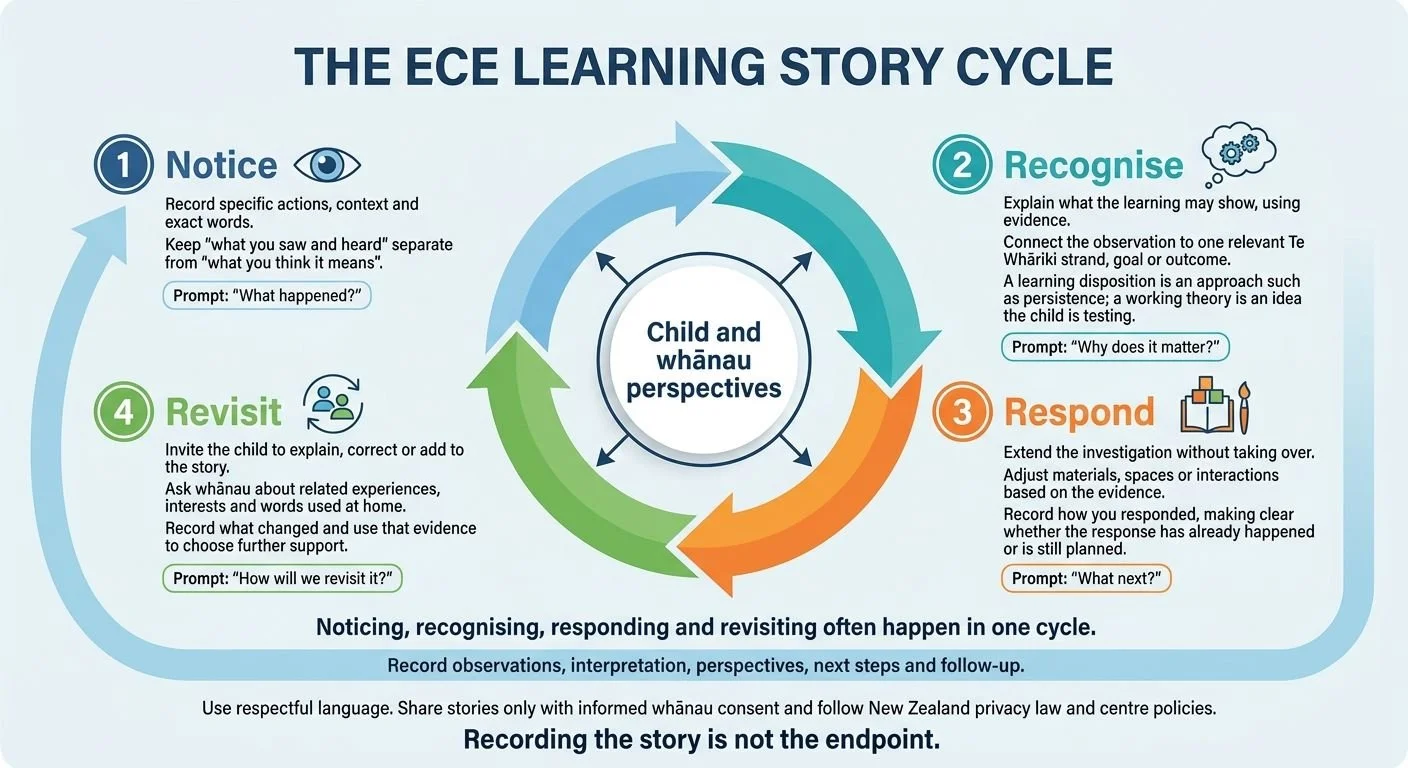
After noticing a moment, respond, record it and revisit it with the child and whānau. Noticing, recognising, responding and revisiting often happen in one cycle. Kaiako may recognise why a new strategy matters and respond during the interaction, then write about it afterwards. Use evidence, children’s explanations and whānau knowledge to guide the next teaching move.
Notice and Recognise Learning
Choose a moment that shows thinking: a question, a change of strategy, a shared challenge or a sustained interest. Keep what you saw and heard separate from what you think it means. Connect the observation to one relevant Te Whāriki strand, goal or outcome.
Hypothetical block-building example:Mila places two blocks beneath a bridge, tests it with a wooden car and moves one support closer to the centre after it tips. These actions are the observation.Mila may be testing a working theory about stability while showing curiosity and persistence.
Respond to Learning and Record It
Help the investigation grow without taking over. In the hypothetical bridge example, offer cardboard tubes or wooden planks and invite Mila to explain her predictions before testing them. Give her space and time to rebuild, or help her work with an interested peer.
Record what happened, what it may show and how you responded, using plain, respectful language. Make clear whether the response has already happened or is still planned.
Revisit Stories With Children and Whānau
Read selected parts with the child. Invite them to explain, correct or add to the account. Ask whānau about related experiences, interests and words used at home, including in their home languages.
Use these perspectives to check what changed after your response. Did the child change their design, explanation or approach? Add that evidence to the record and use it to choose further support. Recording the story is not the endpoint.
How to Write a Learning Story
A Learning Story Template
Build your story around these fields:
Title
Date/time/context
Observation
Interpretation
Te Whāriki connection
Child’s perspective
Whānau perspective
Next steps
Follow-up notes
Use the interpretation to explain what the learning may show. A learning disposition is an approach such as persistence. A working theory is an idea the child is testing. Choose the Te Whāriki connection that best fits the learning, rather than listing strands.
Include the child’s and whānau contributions, or note that you’ve invited them. Revisit the story together, make changes where needed and record what will guide further teaching.
The example below puts the template into practice.
A Hypothetical Arts-Based Story
Discovering New Colours - 14 March*Hypothetical example created for illustration and not attributed to a real child or service.*Context and observation: At the painting table, a child mixed yellow and blue paint, paused to examine the green, then added more yellow. They repeated the process on a fresh sheet.Interpretation: Repeated mixing may suggest curiosity and a working theory about how colours change. This connects with Exploration | Mana aotūroa through experimenting with materials.Child’s perspective: The child’s choices are recorded above; their explanation has not yet been invited.Whānau perspective: Invite whānau to share related interests and colour words used at home.Next steps: Offer the same colours with different brushes and invite the child to predict and explain changes.Follow-up notes: Revisit the paintings with the child and whānau. Record their contributions and whether the child changes their mixing approach. This is a review plan, not an observed outcome.
Once you’ve written the story, check its tone and how it protects privacy.
Respectful Writing and Privacy
Describe strengths, choices, relationships and developing capabilities. Avoid labels or guesses about feelings. Check preferred names, home-language words and te reo Māori with whānau. If you’re unsure about pronunciation or meaning, ask.
Use photographs only when they help explain the learning. Follow the Privacy Act 2020 and centre policies for consent, access, storage and sharing. Get permission for any other identifiable children.
Ask a colleague to check accuracy, respectful wording and whether the story helps guide teaching plans.
Using Learning Stories at Little Dinosaurs Childcare
A learning story’s value comes from what kaiako do with it next.
Little Dinosaurs Childcare is a family-owned centre in Epsom, Auckland, for children aged 2–5. Its arts-focused curriculum is based on Te Whāriki. The examples below show how the centre could put learning stories into practice.
Noticing Learning Through the Arts
Look beyond the finished artwork. How do children mix colours, change their movements or negotiate roles in drama? Kaiako can draw on the team’s varied experience and whānau knowledge to understand what children are trying to do. These details give them something concrete to interpret, respond to and revisit.
Using Stories to Plan Teaching
Linked stories can trace changes in a child’s ideas, relationships and strategies, including during art-making or group drama. Kaiako can use these patterns to adjust materials, spaces and interactions, then record what changed.
Read stories alongside everyday observations, conversations and team reflection. Focus on evidence that helps guide teaching, rather than the number of portfolio entries.
Whānau Input and the Move to School
Whānau knowledge helps kaiako check whether a story reflects the child’s life at home. Invite families to share home experiences, home-language expressions and aspirations through conversations, written comments or voice recordings.
Children could choose photographs and artwork for their records, revisit them and add their own meanings. Use these contributions to shape the next story and the transition plan.
The centre states that it has a strong transition-to-school programme. Stories about making, moving and collaborating can support this focus by highlighting confidence, self-management, communication and curiosity, rather than relying on test-like checklists.
Selected stories can show how a child learns, joins in and copes with change. Share stories only with informed whānau consent and in accordance with New Zealand privacy law.
Conclusion: Observe, Interpret, Respond and Revisit
Used well, learning stories link observations to next teaching steps. One story records a moment; connected stories show how interests, dispositions and working theories change over time.
Keep each part of the cycle linked: observe specific actions and words, interpret what they show, plan a teaching response, then revisit what happens next.
Before finishing, check: What happened? Why does it matter? What next? How will we revisit it?
FAQs
How often should I write a learning story?
The information provided doesn’t specify how often learning stories must be written. At Little Dinosaurs Childcare, educators write them when they observe meaningful progress or key learning moments - not to meet a fixed schedule. These stories document each child’s journey, progress and interests, and are shared with whānau to keep home and the centre connected.
How can I include a child who uses few words?
Put non-verbal expression and a supportive setting first. At Little Dinosaurs Childcare, we encourage children to express feelings and ideas through movement, such as stomping or clapping. Communication boards, visual schedules and hands-on props - including puppets, toys and felt boards - can help children interact and express themselves.
Keep groups small and consistent, and give tamariki plenty of time to respond during conversations. This helps them feel safe to share in their own way.
How can I tell whether my teaching response helped?
Reflect regularly and record what you notice to spot patterns in a child’s development. Use simple checklists during sessions, then review your notes afterwards to see where you could adjust your approach. Watch how children interact to check whether activities meet their needs.
At Little Dinosaurs Childcare, educators record these experiences in portfolios to show each child’s progress. Sharing learning stories with whānau also invites feedback and gives you a broader view of how your support has helped.