
Interactive storytelling can help children learn words - but lasting use is not guaranteed. My starting point: choose two or three useful words, explain them simply, and reuse them through stories, play and everyday kōrero.
A review of 16 studies involving 626 children found a moderate vocabulary gain from dialogic reading compared with typical shared reading. But results differ, and a one-week storytelling trial found no clear word-learning advantage.
Here’s what I take from the research for Auckland parents, whānau and kaiako:
Repeat without pressure: revisit favourite stories and give children time to respond.
Welcome different responses: speech, gesture, art and home languages all give children ways to share ideas.
Keep expectations realistic: understanding a word is not the same as using it independently.
Connect home and early learning: share words and stories with kaiako, with care for te reo Māori and tikanga.
My focus is more chances to communicate - not more testing.
Christopher Lonigan: Implementing Dialogic Reading
What preschool vocabulary studies found
Interactive elaborative storytelling: 293 five-year-olds
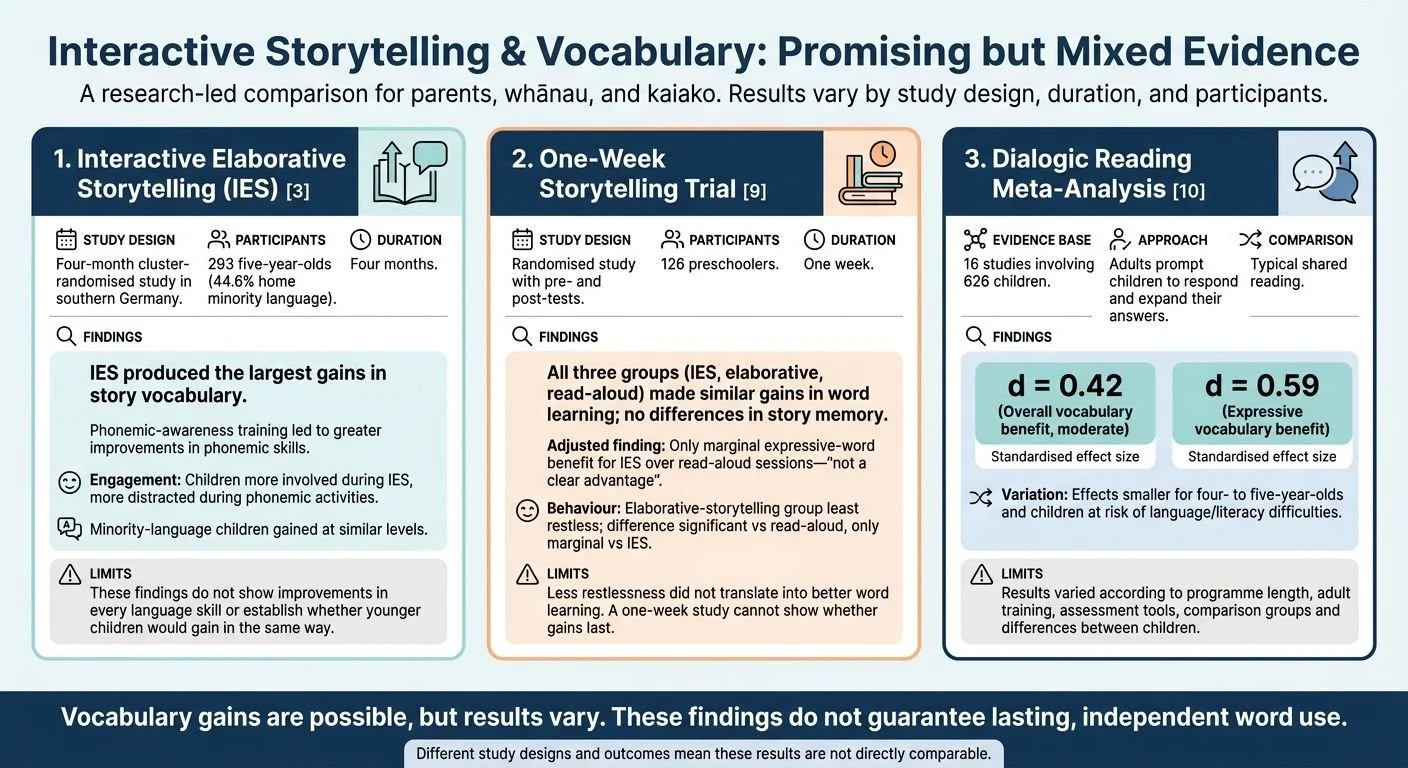
A four-month cluster-randomised study in southern Germany tested interactive elaborative storytelling (IES) with 293 five-year-olds. Of these children, 44.6% spoke a minority language at home.
IES produced the largest gains in story vocabulary, while phonemic-awareness training led to greater improvements in phonemic skills.
Children were more involved during IES sessions and more distracted during phonemic-awareness activities. Those from minority-language backgrounds gained at similar levels. But the findings do not show improvements in every language skill or tell us whether younger children would gain in the same way.
A shorter trial gave less consistent results.
A randomised storytelling study: 126 children
A one-week randomised study with pre- and post-tests compared IES, elaborative storytelling and ordinary read-aloud sessions among 126 preschoolers. Researchers assessed word learning, story memory and behaviour.
All three groups made similar gains in word learning, with no differences in story memory. An adjusted analysis found only a marginal expressive-word benefit for IES over read-aloud sessions - not a clear advantage.
The elaborative-storytelling group was the least restless. This difference met the threshold for statistical significance compared with read-aloud sessions, but was only marginal compared with IES. Being less restless did not translate into better word learning, and a one-week study cannot show whether gains last.
Dialogic reading: A meta-analysis of 16 studies
A larger body of research also points to vocabulary gains, though results vary. Mol and colleagues reviewed dialogic reading: a structured form of shared reading in which adults prompt children to respond and expand their answers. They compared it with typical shared reading across 16 studies involving 626 children.
The review found a moderate vocabulary benefit (d = 0.42), with larger gains in expressive vocabulary (d = 0.59).
Effects were smaller for four- to five-year-olds and children at risk of language and literacy difficulties. Results also varied according to programme length, adult training, assessment tools, comparison groups and differences between children.
Vocabulary gains and research limits
These studies measure different skills, which helps explain their mixed results. Learning a word through direct teaching is not the same as using it independently later. Tests of word recognition, expressive vocabulary and story recall each assess something different. Study length, adult training and the timing of tests also make comparisons harder.
The clearest gains are in short-term word learning, supported by repetition, clear explanations and meaningful contexts. These gains do not necessarily lead to lasting, independent use.
Why children’s results differ
The quality and frequency of interaction may affect progress. One reviewed study found that children understood and produced more new words after three readings than after one or two. Other research found that children learned directly taught words better than words they only heard during reading. Repetition gives children more chances to learn a word, but it does not guarantee they will use it independently.
Children’s existing word knowledge and opportunities to reuse words may also help explain the differences. However, not every study tested these explanations. Recognising a word and producing it without a prompt remain separate outcomes.
Storytelling does not work the same way every time; repeated, meaningful word use matters. Allow children to respond through speech, gesture or a home language. English-only responses may not show everything a child knows.
Using interactive storytelling at home and in early learning
The studies point to a simple pattern: hear the word, talk about it, then use it again.
Explain, discuss and reuse new words
Choose two or three useful words before reading. Give each a simple meaning using a picture or gesture. Pause at natural breaks for predictions or comments, and allow several seconds for children to respond. Younger children may prefer a choice or action, while older preschoolers may explain why something happened. Follow their lead, then return to the story.
Invite children to retell a favourite part or invent what happens next. Build on what they say without correcting every error. Reuse the selected words at meals, outdoors and in everyday conversations, as well as through play and art. These practices are a guide, not a script.
Revisit stories through art, play and home languages
Drawing, puppets, music, movement and role-play give children more ways to revisit story meanings and use the selected words. Treat these activities as extensions of storytelling, not stand-alone causes of vocabulary growth. Te Whāriki guidance links storytelling with thinking up ideas and the arts, including music, dance, weaving and symbols.
Invite whānau to share familiar narratives and words in home languages. Let children combine languages, images and actions as they retell stories. Use te reo Māori with care: check the origins of pūrākau Māori and follow appropriate tikanga. This reflects Te Whāriki’s emphasis on language, culture and identity.
Working in a small group can make these practices easier to manage.
Storytelling at Little Dinosaurs Childcare
At Little Dinosaurs Childcare in Epsom, kaiako could use small-group storytelling, then move into dramatic retelling or collaborative artwork. Across several days, kaiako could note word understanding, independent use, event sequencing and participation through speech, gesture, art or home languages. These observations are informal, not standardised assessments or evidence of centre-specific outcomes.
Conclusion: More chances to hear and use words
The studies point to a simple pattern: interactive storytelling can help children build vocabulary, but gains depend on their language level, adult interaction and how learning is measured. Words learnt through stories do not always carry over into broader language use. Repeated, low-pressure chances to hear and use words matter more than one-off exposure.
Make storytelling part of a language-rich day, alongside conversation and play. The aim is more chances to communicate, not pressure to perform. Children may recognise a word first, then use it with support, before using it on their own. Parents and whānau can share familiar stories and newly encountered words with kaiako, including words from home languages, to connect learning across settings.
FAQs
How can I tell if new words are sticking?
New words are taking hold when your child uses them without prompting in different settings or to express complex ideas. Listen for new vocabulary during role-play, as they describe their artwork, in songs they make up, and in song lyrics they remember.
At Little Dinosaurs Childcare, our kaiako record these milestones in learning stories, showing how your child uses their growing vocabulary.
What if my child won’t talk during stories?
Children take part in different ways. Listening and watching count as participation, too. Puppets can help tamariki feel more at ease sharing feelings or telling stories through a character.
Try tactile props, felt boards or small-group settings that allow room for change to make storytelling feel less overwhelming. Celebrate their efforts and keep the experience fun and free from pressure.
How do I choose words for my child’s language level?
Choose words that match your child’s stage of development and how they learn. Notice whether they pick up individual words and phrases or memorise whole chunks of language.
Build on their interests to introduce vocabulary, whether through music, puppetry or storytelling. Vary your tone when sharing stories, encourage questions about what words mean, and sing repetitive songs with actions. Be patient and give your child time to learn and try out language at their own pace.