For tamariki aged 2–5, I focus on trying art processes - not copying sacred designs. Use washable, non-toxic paint, name the source, and let children make their own marks and patterns.
My starting point is simple: learn where the art comes from, then choose a safe process. Māori-inspired classroom work is not a Māori painting style, and children’s responses should not be presented as the source art.
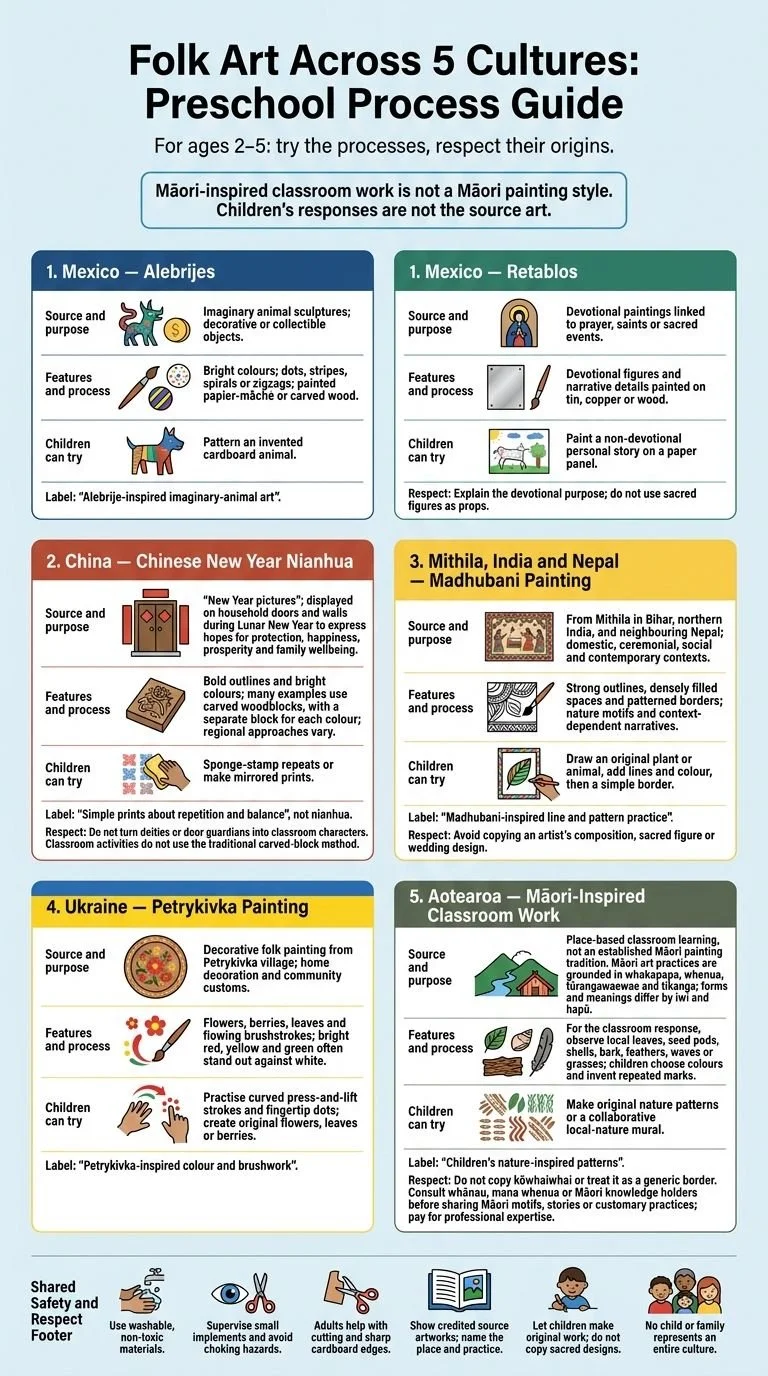
1. Mexican Folk Painting: Alebrijes and Retablos
Setting and purpose
Alebrijes are imaginary animal sculptures; retablos are devotional paintings. Mexico City artist Pedro Linares (1906–1992) is linked to alebrijes made using cartonería, a cardboard-and-paste process, in the 1930s and 1940s.
A retablo is an image placed behind an altar. Mexican retablos grew from Catholic devotional practices introduced during the colonial period. Many show saints, the Virgin Mary or a sacred event. Some were made as votive offerings to give thanks for protection or an answered prayer. Alebrijes are playful and invented, while retablos centre on faith and storytelling.
Motifs and colour
Both forms bring meaning and pattern together. Alebrijes mix animal features with bold colours and dots, stripes, spirals or zigzags. They may have oversized ears, wings, horns or tails. Retablos often depict saints, the Virgin Mary or religious scenes, with details that help tell a devotional story.
Materials and techniques
Linares built lightweight paper-and-cardboard forms, strengthened them with paste, then painted them. Later Oaxacan figures, especially those from San Pedro Arrazola and San Martín Tilcajete, are carved from copal wood and often painted with repeated geometric shapes or dots.
Retablos are painted on flat surfaces such as tin, copper or wood. Tin became especially important during the nineteenth century.
Preschool activities and respect
Use clean recycled cardboard, non-toxic washable paint and thick brushes to make original imaginary animals. Focus on inventing shapes, outlining and repeating patterns rather than copying a shop-bought alebrije or describing the work as genuine Mexican art.
Adults should remove staples, tape over sharp edges and help with cutting. Two-year-olds can paint broad strokes or stamp dots. Older preschoolers can alternate colours or try a dot–stripe–dot pattern. Call the results alebrije-inspired imaginary-animal art.
When looking at a retablo, explain that it is a devotional artwork, then discuss its colours or arrangement.
Next comes China, where festival prints use bold colour and repetition in a different way.
2. Chinese New Year Nianhua
Setting and purpose
Nianhua (年画) means “New Year pictures”. Families have long displayed these images on household doors and walls during Lunar New Year to express hopes for protection, happiness, prosperity and family wellbeing. The tradition takes different forms across regions.
Motifs and colour
Many nianhua feature strong outlines and saturated reds, yellows, blues and greens. Door guardians convey protection, while children, flowers and birds often symbolise wellbeing and good fortune.
Meanings depend on the picture, so don’t give every colour a fixed meaning. Ask children to spot repeated shapes and notice how the figures balance each other.
Materials and techniques
Many makers carved designs into woodblocks, inked them and printed each colour using a separate block. Yangliuqing, Taohuawu and Yangjiabu each developed their own regional approaches.
Yangliuqing, near Tianjin, combines printing with hand-painted details; Taohuawu, in Suzhou, is known for multi-block colour printing; and Yangjiabu, in Shandong, often features bold black outlines and flatter, saturated colours.
Preschool activities and respect
For preschool activities, focus on repetition, symmetry and festive display. Show a few credited museum images and talk about repeated shapes, wishes and how families displayed the pictures at home. Then move into printing.
Children can use washable, non-toxic paint to sponge-stamp a repeating border. Another option is to fold paper in half, add a little paint to one side, close it and press gently. Opening the paper reveals a mirrored pattern.
Give younger children large sponge shapes and one or two colours. Older preschoolers can plan a repeating border or compare two regional examples.
Do not turn deities or door guardians into classroom characters. Describe children’s work as simple prints about repetition and balance, not nianhua. These activities echo nianhua’s repetition and symmetry, but do not use its carved-block method.
Next, Indian Madhubani painting shifts from printed images to hand-drawn line and pattern.
3. Indian Madhubani (Mithila) Painting
Setting and purpose
While nianhua uses printed repetition, Madhubani uses hand-drawn lines, densely filled spaces and patterned borders.
Madhubani painting comes from Mithila in Bihar, northern India, and neighbouring Nepal. Women painted household walls and floors for domestic, ceremonial and social occasions. Today, artists also work on paper, cloth and canvas.
Motifs and colour
Strong outlines, flat colour and repeated borders define the style. Flowers, leaves, fish, birds, trees, the sun and moon often fill the compositions. Some paintings show Hindu deities, weddings and social life, so their meanings depend on the context.
Materials and techniques
Artists have used fingers, twigs, matchsticks and nib-pens to make their marks. Earlier pigments came from turmeric, indigo, rice powder, soot and plant dyes. Contemporary artists also use commercial paints. These tools work well for the style’s fine outlines and flat colour.
Preschool activities and respect
For children aged 2–5, provide large sheets of paper, thick crayons, washable felt-tip pens or short-handled brushes. Use washable, non-toxic paint. Invite each child to draw their own plant or animal, give it a clear outline, fill it with colour and add a simple border. Younger children can work with one large shape and a few dots or lines.
Name Mithila and show credited artworks so children can connect the activity to its source. Avoid copying an artist’s composition, sacred figure or wedding design. Describe the children’s work as Madhubani-inspired line and pattern practice, rather than Mithila painting itself.
4. Ukrainian Petrykivka Painting
Setting and purpose
Petrykivka painting is a Ukrainian decorative folk style from Petrykivka village in central Ukraine. It started as home decoration and was added to UNESCO’s Representative List of intangible cultural heritage in 2013.
Like the other styles in this article, Petrykivka turns everyday surfaces into art. But instead of print or heavy outlines, it uses flowing brushstrokes. This makes a clear contrast with the denser patterns in the earlier styles.
Motifs and colour
Petrykivka features stylised flowers, leaves, berries, buds and curling stems. Bright red, yellow and green often stand out against a white background. Large clusters of flowers or berries lead into smaller buds and grass-like strokes, creating flowing borders and garlands.
Materials and techniques
Use child-sized round brushes to practise curved press-and-lift strokes: press down to widen the stroke, then lift to narrow it. Children can use fingertips to make berries. Cotton buds can add small dots, with close supervision.
Preschool activities and respect
Make a shared paper garland using sturdy white panels. Introduce its Ukrainian source through credited examples, then let children practise brush movements on scrap paper. They can add their own flowers, leaves or berries to the panels, trying out repeated patterns along the borders.
Once the panels are dry, join them into a border. Label it Petrykivka-inspired colour and brushwork and display it at children’s eye level.
Next, compare how the five styles use line, colour and repetition in different ways.
5. Māori-Inspired Patterns in Aotearoa
After Petrykivka’s flowing brushwork, this final example moves from a named painting style to Māori-inspired, place-based pattern work in Aotearoa. It’s not a direct folk-painting equivalent.
Setting and purpose
Māori pattern work in Aotearoa is grounded in whakapapa, whenua, tūrangawaewae and tikanga. It’s more than decoration. It includes living customary and contemporary practices, with forms and meanings that differ by iwi and hapū.
Like the other examples, it uses repetition and pattern. The difference lies in how closely its meaning is tied to whakapapa, place and tikanga.
Motifs and colour
Kōwhaiwhai on wharenui rafters and ridgepoles carries whakapapa and ancestral meaning. Don’t treat it as a generic classroom border. Instead, observe local leaves, seed pods, shells, bark, feathers, waves and wind-blown grasses. Let children choose colours from their surroundings.
Materials and techniques
Offer washable paint, crayons, paper, cardboard and recycled materials. Children can use these to make lines, repeated marks, leaf prints and collage.
Use fallen leaves, seeds or bark where permitted. Don’t remove living plants or harvest harakeke without permission and guidance.
Preschool activities and respect
Observe the local environment together and draw the shapes children notice. Then invite them to make original patterns and explain their choices.
Keep the learning centred on observation, identity, place and relationships. This supports Te Whāriki’s Mana Whenua through connection to place and Mana Reo through visual expression. Describe the results as children’s nature-inspired patterns, not Māori-made art or copied Māori design.
Before introducing motifs, stories or customary practices, ask whānau, mana whenua or Māori knowledge holders what may be shared, which tikanga apply and how to acknowledge the source. Pay for professional expertise.
Comparing the 5 Approaches
These five art traditions, alongside Māori-inspired classroom work, differ in purpose, motifs and process. The tables below show what each involves and how children can respond to it.
Conclusion: Try the Processes, Respect Their Origins
These approaches share colour, observation, repetition and storytelling. But each has its own purpose, symbolism and meaning for its community.
Choose a safe, open-ended process that lets children lead and make original work, guided by the relevant culture. Keep Māori-inspired classroom work distinct from Māori art traditions. Invite whānau to share knowledge on their own terms. No child or family should be asked to speak for an entire culture.
Try the processes, learn the context, name the source, and let children create from their own experiences.
FAQs
How can I explain cultural respect to preschoolers?
Celebrate children’s backgrounds by bringing family traditions, stories and festivals into daily art activities. This helps every child feel that their heritage matters.
At Little Dinosaurs Childcare, educators use emotion words in children’s home languages and introduce te reo Māori. When working with Māori patterns or Pasifika designs, ask whānau for guidance. Show care and curiosity so children see that every contribution matters and everyone belongs.
How can I adapt these activities for sensory needs?
Keep it simple and personal. Offer materials that are easy to handle, such as soft brushes, textured papers or non-toxic paints. Provide alternatives for children with sensory sensitivities and larger tools for those with fine motor challenges.
Break instructions into small, clear steps and follow each child’s preferences. Some may enjoy clay modelling; others may prefer quieter activities like colouring. Keep the space calm and supportive so children can try things at their own pace.
How can I find culturally appropriate art examples?
Connect directly with your community and the families in your care. Invite whānau to share their customs, crafts and stories, and use these contributions to shape meaningful activities. For Māori motifs, such as koru or kōwhaiwhai, consult local iwi or Māori whānau to ensure you represent them respectfully and accurately.
Little Dinosaurs Childcare takes this approach by working with whānau to understand and celebrate the community’s diverse cultural values.