How Multilingual Storytelling Builds Cultural Connections
I start with connection, not perfect fluency. For children aged 2–5, sharing stories in two or more languages can help them feel they belong and connect with others.
My approach is simple:
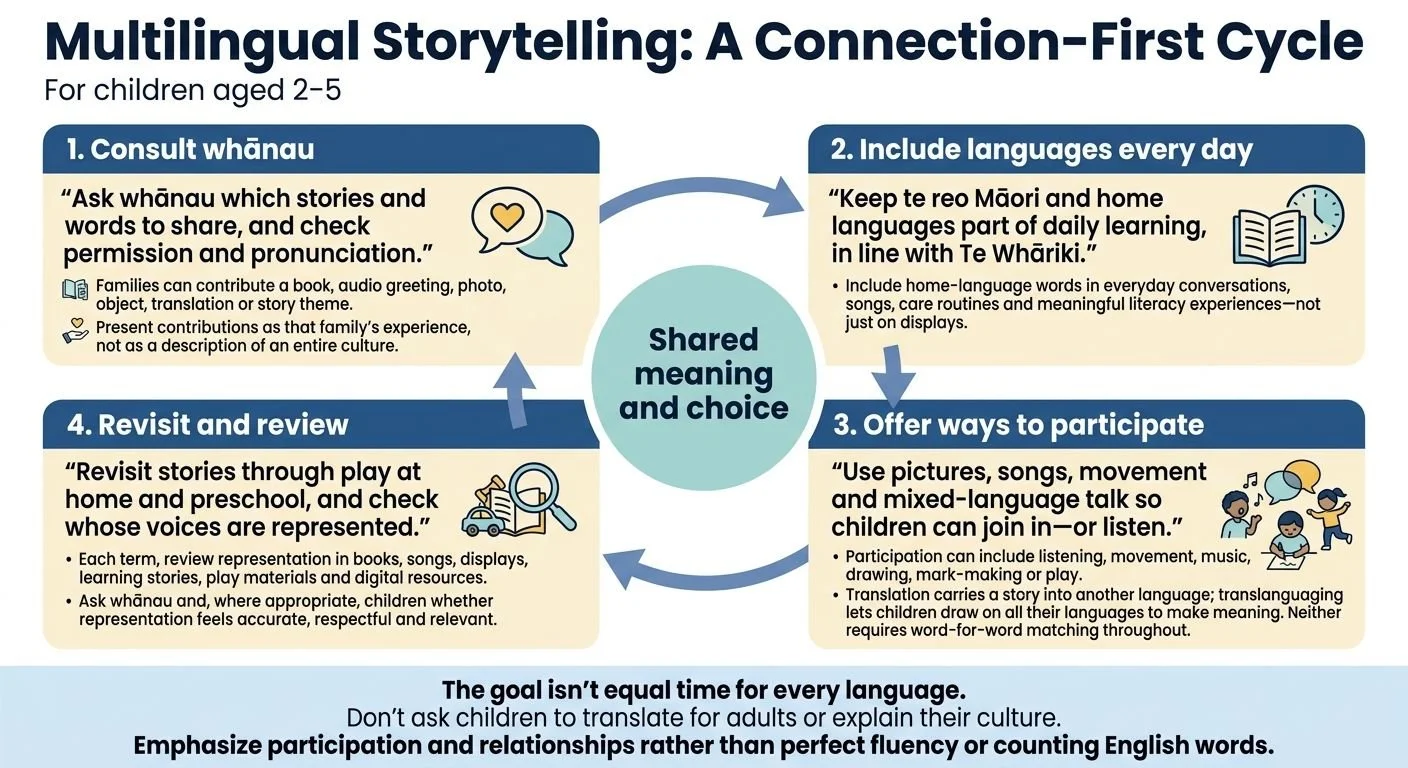
Ask whānau which stories and words to share, and check permission and pronunciation.
Keep te reo Māori and home languages part of daily learning, in line with Te Whāriki.
Use pictures, songs, movement and mixed-language talk so children can join in - or listen.
Revisit stories through play at home and preschool, and check whose voices are represented.
The goal isn’t equal time for every language. It’s shared meaning and choice, without asking children to translate for adults or speak for their whole community.
How Stories Connect Children Across Languages
Shared Stories and Different Perspectives
Children build meaning together by connecting a character’s experiences with their own. Familiar themes - friendship, family, food, animals or celebrations - give them a starting point for understanding something new. Kaiako can draw attention to words, sounds, rhythm, pronunciation, gestures and illustrations without ranking languages.
Whānau can offer different perspectives. Present each contribution as that family’s experience, rather than a description of an entire culture.
Keep shared meaning at the centre. Relationships built over time matter more than one-off language activities. Translation and movement then help children join in, even when they don’t share a language.
Translation and Translanguaging
Translation carries a story into another language. Translanguaging lets children draw on all their languages to make meaning. Translation helps more children access a story, while translanguaging gives them choices about how to contribute. Neither needs word-for-word matching throughout.
Support home languages in everyday storytelling. Use pronunciation shared by whānau, dual-language books and familiar songs, and welcome mixed-language contributions. Don’t ask children to translate for adults or explain their culture. Recognising their language and knowledge each day matters more than a one-off performance. These choices help children prepare to tell the story back in their own way.
Child-Led Stories, Pictures and Movement
Once children recognise the story, offer different ways to retell it. They can retell, sing, draw or stay quiet. Let them return later in their own way.
Pictures help with sequencing; puppets offer a speaking partner; role-play, music and movement let children communicate actions and feelings.
Notice whether children pick up one another’s ideas and invite peers into play - not just how many English words they use. Look for participation, shared ideas and how peers respond.
The OWL Project: Strengthening Linguistically Responsive Pedagogy in Preschool
Planning Multilingual Storytelling
Plan multilingual storytelling around participation, rather than a perfect balance between languages.
Before: Consult Whānau and Choose Stories
Once children know the story, plan with whānau how to choose and share it. Ask whānau which stories suit their culture, and check meaning, pronunciation and permission before sharing.
These conversations build two-way relationships and show respect for each family’s language, culture and knowledge. Acknowledge each child’s right to experience Aotearoa New Zealand’s bicultural heritage under Te Tiriti o Waitangi.
During: Support Understanding and Choice
Support understanding and choice through translation, bilingual read-alouds, translanguaging circles and child-led retellings. Include pictures, movement and song to help children take part.
After: Revisit Stories Through Play
Return to the story through play at preschool and at home. These moments help children strengthen language links and deepen their understanding, while bringing the story into daily routines.
Making Storytelling Part of Everyday Learning
Make multilingual storytelling part of daily routines. Education Review Office (ERO) guidance recommends using home-language words in everyday conversations, songs, care routines and meaningful literacy experiences - not just on displays.
Working with Whānau and Welcoming Every Child
Give whānau easy ways to contribute, whether through a book, audio greeting, photo, object, translation or story theme. Then check whose languages and stories children see and hear across the setting.
Each term, review the languages and storytelling traditions represented in books, songs, displays, learning stories, play materials and digital resources. Participation goes beyond speaking: children can join through listening, movement, music, drawing, mark-making or play.
Ask whānau and, where appropriate, children whether this representation feels accurate, respectful and relevant. Keep te reo Māori part of everyday learning, rather than treating it as an occasional theme.
Storytelling at Little Dinosaurs Childcare
Little Dinosaurs Childcare’s small group size, arts focus and Te Whāriki-based programme suit story circles and bilingual artworks. Whānau should still guide language and cultural representation.
Conclusion: Building Connections Through Stories
Multilingual storytelling helps children connect with their cultures when daily learning includes home languages, whānau input and different ways to take part.
FAQs
Can multilingual storytelling confuse my child?
No, multilingual storytelling does not confuse children. Research and teaching practices at Little Dinosaurs Childcare show that stories and songs in different languages help children develop language skills and learn more about the world.
This approach helps children recognise shared patterns, build their vocabulary and strengthen their communication skills and cultural identity. It also aligns with Te Whāriki, supporting inclusion and helping children feel valued.
How can I share stories in a language I don’t speak?
Use gestures, eye contact and expressive body language to bring meaning to the story. Props, toys or pictures can help children follow along. Singing songs in different languages, or using familiar tunes with translated lyrics, helps children spot patterns and build vocabulary.
At Little Dinosaurs Childcare, we encourage families to share songs or stories from their heritage. It’s a way to celebrate diversity and build meaningful connections for all tamariki.
What if my child avoids their home language?
Children can have different communication styles, including Gestalt or Analytic learning styles. At Little Dinosaurs Childcare, we work alongside whānau to support each child’s development. Support your child’s home language with daily songs, stories and music from your heritage. These help build meaningful links between home and our centre.
If you’re concerned about language milestones or development, speak with a health professional early to get appropriate support.